Friday, February 10, 2012

And so it begins.

In March I’ll be commencing a PhD in History at the University of Western Australia – which means I will be spending the next three years investigating a research question that keeps me up at night. It’s an amazing opportunity made even better by the fact that the university has offered to support me with a scholarship while I am doing it. I like to think of it as a completely wonderful (but extremely underpaid) new job that just so happens to be equally thrilling, terrifying and the most difficult thing I have ever done.

My research project will investigate the influence of consumer culture on the Anzac Legend and Australian national identity - in particular, the ways in which an increased public fascination with the Anzac Legend since the 1980’s has been articulated and commoditised by memory industries including publishing, tourism and entertainment.  I’m a public historian at heart and through my research I hope to better understand non-academic forms of historical engagement  as well as the ongoing - and growing -  fascination Australians have with the past.

During this time I have a feeling that this blog will remain an important creative outlet where I can:
  • share untold stories from Australian history
  • explore the intersection of history and digital media
  • curate and share thought-provoking content from blogs & websites I follow 
  • try out different writing styles and develop my own voice as a historian
  • experiment with digital storytelling in diverse formats including photography, videos and podcasts
  • play with new ideas and get feedback from a community of fellow history nerds
  • keep connected with the outside world during the PhD researching and writing process
Historypunk is likely to remain a delightfully eclectic space - hopefully full of interesting bits and pieces to keep you entertained and inspired. There's a long road ahead so perhaps it will also inspire me too and serve as a reminder of why I fell in love with history in the first place.

Here goes nothing!

Tuesday, February 7, 2012

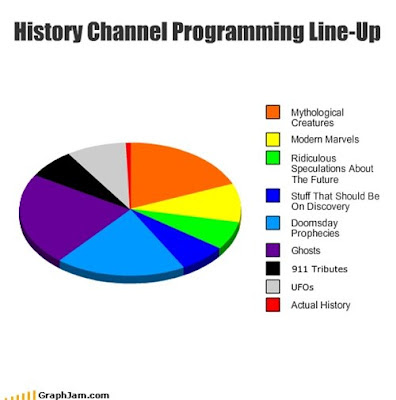
History on TV

Remember when The History Channel showed historical documentaries?


Friday, February 3, 2012

Will future historians face a Digital Dark Age?

Lack of historical evidence has always been one of the greatest frustrations facing historians. Skills such as reading and writing were long the preserve of a privileged few – resulting in a historical record that often reflects the voices of those in power and obscures the lives of ordinary men and women.

All of which makes the recent creation of the largest and most democratic archive of information that humanity has ever seen pretty darn exciting. Behold – the internet!

Yet, despite promising a tantalising treasure trove for future historians our digital heritage is in danger of being destroyed. Digital preservation is not just an issue for historians, it is important for everyone wishing to preserve precious memories for future generations - photos, video or correspondence - in our digital world.


Here are five things you need to know.


1. Much of our cultural record is now ‘born digital’.

Records that are ‘born digital’ include websites, correspondence (such as email), digital photos, digital music files and ebooks. Unlike paper records or film negatives, this information is often stored solely in digital archives. We must find ways to store this data or risk losing it.


2. Digital data is extremely challenging to store for long periods of time .

There are several reasons for this. Firstly, the technologies for storing digital data are prone to decay. There is no way to tell exactly how long a burnt DVD, CD or external hard drive will last but the amount of time is likely to be shorter than you think – estimates vary from 2-5 years. Secondly, even if data is preserved perfectly, data will be lost if the technology that gives us the ability read it becomes obsolete. The U.S. Government found this out the hard way in the late 1970’s when they tried to access data from their 1960 census. By this time there were only two machines left in the world that could read the data (one was in Japan, the other in the Smithsonian Institution). Finally, the amount of data in humanity's digital archive is increasing exponentially. Researchers from University of Southern California have estimated that the volume of digital records overtook analogue records in 2002 and by 2007 (five short years!) over 90% of memory was in digital form.

3. These challenges mean that digital archives need careful management.

Unlike paper records, which often survive despite being abandoned for centuries, digital records will disappear quickly if forgotten. While your grandparents may have tucked away their old photos and papers in a shoebox for decades, digital data does not offer this luxury. The emerging field of digital archaeology is manned by specialists whose task it is to retrieve information and record these technologies.


4. There is only one known way to preserve your digital data.

Keep it moving! Think of your digital archive as a river of data. To keep it flowing you need to regularly move digital photos and documents into new formats. Here are some tips for preserving your digital memories:
  • Recognise that you need to actively manage your own digital archive.
  • Back everything up. Files should exist in at least two difference places in case one format fails or corrupts.
  • Keep external hard drives in a dry, cool , safe place, eject them from your computer properly and for goodness sake, don’t drop them!
  • Shift data onto a new formats every 2-5 years
  • And my best tip? Print out your photos and put them in albums. Retro, right? Printing your photos is inexpensive and a physical photo is still far more likely to be around in 50 years than one saved on a hard drive. Those emails you sent your family while you were on that backpacking trip in Europe? Print those too.

5. Digital archives will transform the way historians work in the future.

While digital archives (including social media such as Twitter and Facebook) are likely to offer future historians rich insights into the lives of a diverse range of people – they will also require the development of new tools to find meaning in an ocean of data. Storage of this data will require both time and money. Who will choose what records survive and which do not? It just may be that we see a kind of digital Darwinism come into action.

Or perhaps, in some cases, even a return to analog technology? The Rosetta Stone is wonderful example of the beauty of simplicity. The stone tablet, created over 2,000 years ago, was rediscovered in Egypt in 1799. It contains a single decree inscribed three times – in Greek, demotic and hieroglyphic. It was the hieroglyphic text that caused a sensation. Hieroglyphs were rarely used after the fourth century AD and the knowledge of how to read them had been lost. This single stone unlocked much of the world of ancient Egypt. When I was living in London, sometimes I would call into the British Museum just to see it.

Inspired by this simplicity, The Rosetta project is a contemporary effort to preserve the world’s many written languages. Academics have created a metal disk engraved with records of over 1,500 languages. The cover of the disc contains the following message for the reader;“Languages of the World: This is an archive of over 1,500 human languages assembled in the year 02008 C.E. Magnify 1,000 times to find over 13,000 pages of language documentation.”. Like the Rosetta Stone, it is hoped the tablet will survive for over 2,000 years.


The Rosetta Stone - Image courtesy of the British Museum.

The Rosetta Disc - Image courtesy of the Rosetta Project.


Thursday, January 19, 2012

Do you recognise Perth in the 1950s?

I was reminded of this fantastic film the other day and felt compelled to share it. Produced by the Australian National Film Board in 1954, the wonderful ‘Postcards From Perth’ was created to promote Western Australia to tourists and immigrants. Back then, as it is now, the city was one of the most isolated places in the world.


At times the city seems almost unrecognisable. St Georges Terrace has always been the main city thoroughfare however, over the twentieth century, it has evolved from a 'gracious boulevard' to a 'windswept canyon of concrete, steel and glass'.

How did this 'gracious boulevard' come into existence? Many of the finest buildings along the Terrace were constructed during the gold boom that spanned the 1890s. During this time Perth became home to some of the grandest hotels and theatres in the southern hemisphere.

After the Second World War, development was both inevitable and badly needed. Rapid population growth led to the development of new suburbs, new freeway systems and the transformation of the Swan River by the narrows bridge (1959).

The film is important because it captures a city at a turning point. I can't help but be struck by how much has changed. Not only the unfamiliar skyline but the tram line (which used to extend all the way to the western suburbs) - even down to the wrought iron street lamps.

Yet, hindsight makes it all too easy to criticise postwar development. In 1950’s Perth the air was filled with progress, prosperity, optimism and change. Older buildings became easy victims of a desire for new technologies and modern conveniences.

If you are interested in exploring lost Perth the State Library of Western Australia has incredible archive of photographs that span as early as the 1860’s, some of which have been celebrated in a fantastic Facebook group.

You’ll find that many of these early images were produced in strikingly high resolution, certainly comparable to today’s digital cameras. I’ve often thought about printing out some favourites on canvas although to this date I have found it too hard to choose!

Tuesday, December 6, 2011

Hidden histories: Aboriginal country music

Since handing in my history dissertation I’ve (finally) set my turntables up and have been spending a lot of time rediscovering my music collection. While sorting through jazz, northern soul and hiphop today I came across an old Buddy Williams record.

Williams was one of the first Australian country music performers. Originating in the United States, country music was born out of contradiction - a clash between Europe and Africa with roots in folk, celtic and gospel music.


Known initially as ‘hillbilly music’, Australian performers began to localise American songs in the 1930’s and 1940’s in which hobos became ‘swagmen’ and cowboys became ‘boundary riders’ or ‘ringers’. They also began to write new material and developed the first Australian bush ballads. For rural Australians, this simple and unpretentious music didn’t just talk about their life, it talked like their life.


Artists such as Tex Morton, Buddy Williams and Slim Dusty spent their careers touring rural Australia, and often performed in remote areas, aboriginal settlements and missions. From the beginning, indigenous Australians felt connection to country music - story songs telling tales of land and country, of leaving home and coming back again. The music also had an intangible quality with simple rhythms that could express complex feelings of longing and loss.


In addition, country music was inherently egalitarian. Guitars and harmonicas were portable, easy to play and cheap. In fact, it was common in the early days for performers to make their own instruments. The first time Slim Dusty heard country music he was seven years old – and it was sung by an Aboriginal man playing a homemade guitar.


As I played the record I was reminded of a story told and retold by my grandparents who grew up and lived (as I did) in Mullewa, a small country town in Western Australia's north. In 1966 Buddy Williams visited Mullewa to perform a concert in the Town Hall. It was exciting day for the entire town, including the Yamaji community. The day was tinged with sadness for the Dingo Family, as they were mourning the loss of a family member.


Les Dingo was well known in Mullewa and throughout the Murchison - a handsome Yamaji man with a huge smile and even bigger personality. He had died tragically six months previously as he attempted to cross the Gascoyne River during a flood. Williams had known Les from his buckjumping days, and his regular attendance at his shows. As a gesture of honour he invited Les’s Mother Ulie and his family to attend the concert for free.


The Town Hall was packed to capacity, and during the second half on the concert, Buddy sang a new song;

The Gascoyne river was in flood.
It was running wild and wide
Carnarvon town was cut right off.
And was short of food supply.
The mailman couldn’t get to town
Cause the Gascoyne was too high
So he left the mail for Carnarvon folks.
On the bank of the river side.
A coloured man with heart so brave
Volunteered to get the mail
He swam the raging rivers wild
Les Dingo was his name.
Les Dingo was his name
Les Dingo he died game
A coloured man with a great big smile
Les Dingo was his name.
Upon hearing the words, Ulie rose from her seat and walked slowly to the front of the stage where she stood with tears running down her face. Buddy, his band, and many of those in the audience cried too. It was an extraordinary shared moment in a town divided. During a time in which Australia’s indigenous population were marginalised within society, Mullewa’s Yamaji community was placed centre stage.

This story is not uncommon; before anything else, country music gave aboriginal people a voice in Australia.
My next post will explore some stunning contributions of Aboriginal musicians to jazz, rock & roll and country music in postwar Australia... and reveal a lost classic album of black protest music that every Australian should hear.

Friday, July 22, 2011

How to come up with a good idea.

Writing a dissertation is a strange process - most of all due to the incredible amount of information consumed in the process. Piles of books and hundreds of journal articles. Some baffling, several almost unreadable, others compelling (and more than a few enviously original). How to make sense of it all? Connecting the dots can be an arduous process and at the moment the search for good ideas seems to involve a lot of writing and a good deal of time staring into space. Waiting for inspiration can feel daunting however the history of ideas reveals fascinating insights into the vastly different ways societies have approached the creative process.

Elizabeth Gilbert’s 2009 lecture on the history of creativity has got to be one of my favorite TED talks. She notes that the concept of a 'genius' today is completely different from in the past. In ancient Greece and Rome people did not believe creativity came from human beings, rather that inspiration originated from a divine spirit and was channeled by the artist (the Romans called this guiding spirit the 'genius'). The Renaissance changed everything. Rational humanism knocked the divine from centre stage and placed the individual at the centre of the universe. It followed that people began to believe creativity came from the individual. Do yourself a favour and check out the full talk below.


Gilbert advises we should be kinder to themselves and her advice echoes that well known mantra that good ideas come from 1% inspiration and 99% perspiration.

‘Just do your job. Continue to show up for your piece of it, whatever that might be.’

Academic and author Steven Johnson is also fascinated by where good ideas come from but takes a different approach. He is obsessed with the patterns and environments linked to innovation. Those amazing ideas you have every now and again? Well, Johnson doesn’t believe they come out of thin air; rather they are created from dormant, partial ideas that slowly mature over time. This is why collaboration is so fantastic, it allows you to combine fragments of ideas with others and create something larger than the sum of two parts.


As for me? Well, I'm going back to the grindstone. Wish me luck.

Thursday, July 7, 2011

Q & A: Professor Geoffrey Bolton

It's not often you get the chance to have a coffee with one Western Australia’s most celebrated historians. In 1954, Professor Geoffrey Bolton completed his masters thesis in history at the University of Western Australia. This year I am working on my own and I'm keen to hear about his experiences. When he meets me at a university cafe, he has just come from the library where he has been researching his latest book.

During our chat, Bolton expresses an infectious enthusiasm when describing the thrill of finding ways back into the past using archives and oral histories. It is this challenge, I think, that has sustained him throughout a dynamic career that has included numerous books and academic papers as well as teaching and leadership in public history. Through his arresting and accessible prose, Bolton has helped uncover countless hidden Australian histories.

How did you get started in history?
The right kind of teacher at the right time is important. Professor Fred Alexander (the founding Head of the Department of History at UWA) was quite influential. We were both fascinated by the opening up of the American west. When I commenced by masters, he found 100 pounds from somewhere - told me not to ask for a penny more - and sent me up north to write a history of the Kimberley pastoral industry. At the time it was very isolated and it was an incredible experience. When I finished the thesis I got a Hackett scholarship to Oxford University. I wanted to shift because Australian history is good and there is a lot to do, but it is important to have a global perspective. So all of that went into developing a historical imagination.

How do you work?
I was taught that you have to get hold of the evidence, get hold of the documents. Also, because of the work I had been doing in the Kimberly, I needed to come to grips with oral history early on. I’ve always thought oral history was a useful way to access the past. The thing about oral history is that often it concerns feelings and emotions about something rather than facts. People make mistakes about facts, but that doesn’t mean you have to discount what they are talking about. It’s a way in. For example, when I wrote ‘A Fine Country to Starve In’ we did lots of interviews. What we found was that, for people who had a hard time, the wives wanted to talk the ways they had managed, innovated and economized however the men didn’t want to talk about it as they were ashamed.

A certain level of empathy is central to good history. I remember seeing a colleague and noticing he was looking unusually haggard. I asked him why and he said it was because of a history he was writing about a notorious employer in the early coal industry. He said;
“Geoff, I’ve been trying for the last fortnight to put myself in his shoes. I’m not going to change my views but until I understand what made the bastard tick I’m not going to write anything worthwhile!”

What are your thoughts about Australian history writing in the 21st century?
I think people often look at history as a series of milestones rather than a process of continuity. For example, the 1988 Bicentennial and the 2015 Anzac Centenary. We need to be careful of that. If you limit focus to the big moments, people can slip out of immediate memory and things get lost in between. Someone who is 100 years old has a valuable story to tell, however so does someone who is 50 years old. We shouldn't wait until it becomes urgent to preserve these stories.

I can now see, what I couldn’t see when I was writing history 50 years ago, how memory places an increasingly important role in society. People are constructing myths 50 years later. Sometimes it wasn’t like that.

People like Marilyn Lake and Henry Reynolds have talked about the Anzac legend and militarization of Australian history but you need to remember that people are fascinated by it. When I taught European history the French Revolution and Hitler's Germany were always most popular with students as there was such a lot of action.


What drives you as a historian?
It is a lifetime profession. I suppose there is that thing that you just might just make the next project a little better than the others. There is always that challenge. Early on you have models (other historians) that you follow however I always enjoyed it as a form of writing. It is a narrative and it should be directed at the general reader. It’s important to write clearly and lucidly. It’s important to bridge academic and public audiences and the more you do it, the better you get at it.

If anything my writing style has relaxed. Early on in my career I can see examples when I was trying to write with conscious elegance. I don’t necessarily do that now. You’ll never have perfection, the most you can do is avoid deliberate error.